
Soil Types and Their Challenges: What They Mean for Your Irrigation Schedule
- Why Soil Texture Drives Irrigation Decisions
- The 6 Main Soil Types and Their Challenges for Watering
- Testing Your Soil Before You Touch the Controller
- Building an Irrigation Schedule Around Your Soil Type
- Plant Selection and Watering Behavior
- Key Takeaways: Matching Irrigation to Soil Behavior
- Dealing with Runoff, Pooling, or a Lawn That Won’t Green Up?

Soil types and their challenges affect everything from how well your garden grows. They determine how water moves through your yard, and that single fact drives almost every irrigation decision you’ll make. Here’s a quick overview:
| Soil Type | Typical Infiltration Rate | Irrigation Challenge |
|---|---|---|
| Clay | 0.1–0.2 in/hour | Runoff and pooling, if applied too fast |
| Sandy | 0.8–1.0+ in/hour | Water moves past the root zone before plants absorb it |
| Silt | 0.3–0.5 in/hour | Compacts easily, which slows absorption over time |
| Loam | 0.5–0.7 in/hour | Few issues, but still benefits from scheduled monitoring |
| Peat | Under 0.1 in/hour | Holds water long after a cycle ends |
| Chalky | 0.6–1.0+ in/hour | Limited root-zone depth shortens effective run-times |
A lawn that won’t drain, brown patches that won’t green up, or a system that seems to run constantly without results are common complaints. In most cases, the soil underneath the lawn is the reason, not the sprinkler heads.
Soil is a living mix of mineral particles, organic matter, water, and air. That mix controls how fast water soaks in and how long it stays available to roots. Get the soil texture wrong in your scheduling, and you’ll either lose water to runoff or starve the lawn between cycles.
New Jersey conditions shift block by block. Sandy coastal soils along the Monmouth County shoreline behave nothing like the dense clay found a few miles inland. The same run-time on two different properties can produce two very different results.
This guide focuses on how soil texture affects infiltration and irrigation run-times. For a full assessment of your property’s specific zones, see our guide to scheduling an irrigation audit. For controller upgrades and system-wide efficiency improvements, visit our smart irrigation services hub.

Why Soil Texture Drives Irrigation Decisions
“I’m a Certified Landscape Irrigation Auditor,” says Guy, our resident irrigation specialist.
“When I walk a property in Colts Neck or Howell, the first thing I check isn’t the grass, but how the soil under it behaves when water hits it. Two lawns can look identical above ground and need completely different watering schedules below it.”
That’s the core problem with clock-based controllers set on a single generic schedule: they ignore the one variable that determines whether water actually reaches the roots. A schedule built for loam will drown a clay-heavy yard and barely touch a sandy one.
Precipitation Rate vs. Infiltration Rate
Two numbers decide whether a zone runs efficiently or wastes water.
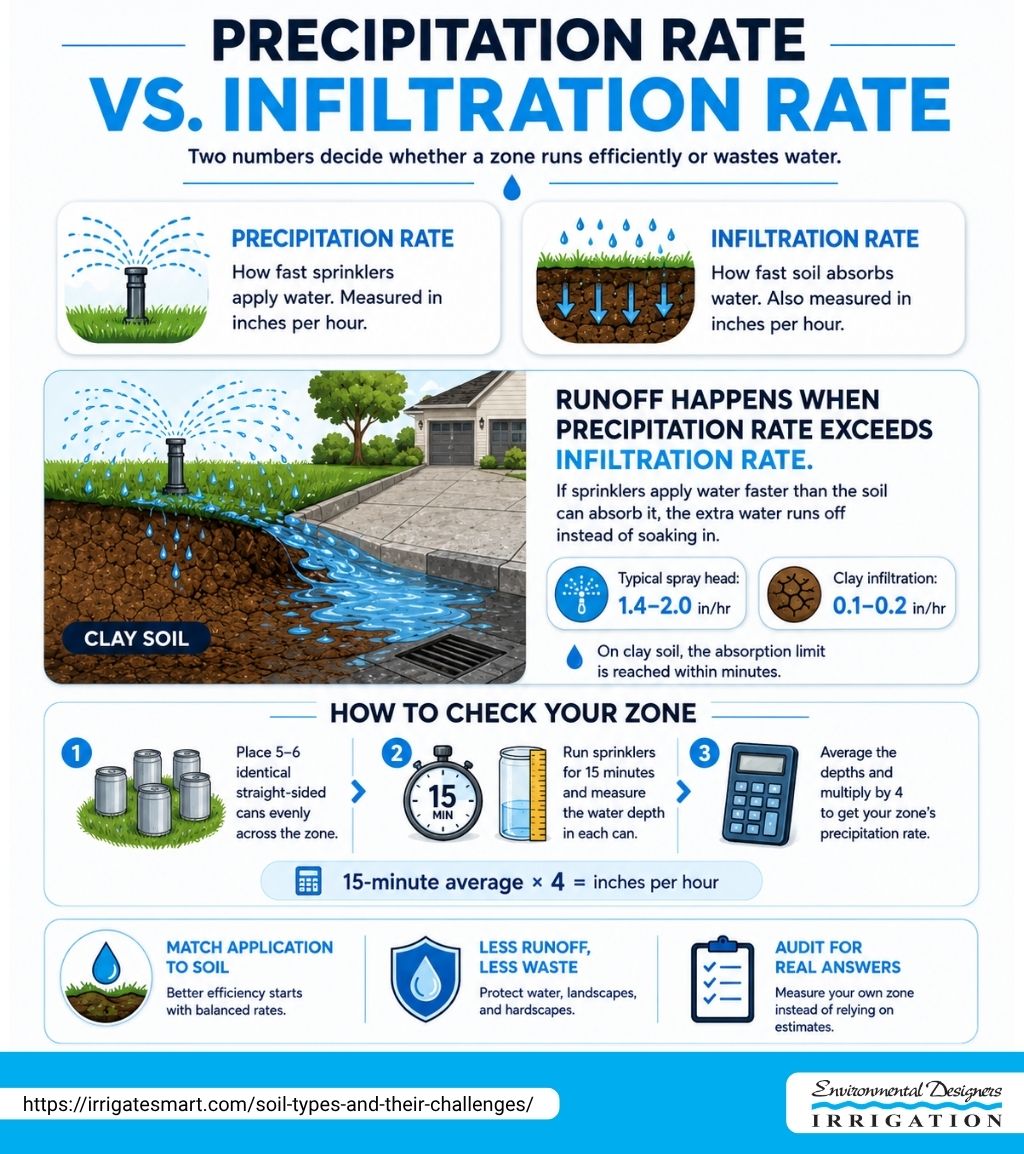
Precipitation rate is how fast your sprinklers apply water, measured in inches per hour. Infiltration rate is how fast your soil can absorb it, also measured in inches per hour.
The Irrigation Association’s auditing standards define runoff as the result of precipitation rate outpacing infiltration rate. The sprinkler puts water down faster than the ground can take it in, regardless of how long the zone runs.
A standard spray head typically applies 1.4 to 2.0 inches per hour. Clay’s infiltration rate runs 0.1 to 0.2 inches per hour. A clay zone hits its absorption limit within the first few minutes, and everything applied after that point runs off toward the driveway or street.
You can measure your own precipitation rate with a version of the same test that irrigation auditors use.
- Set out five or six identical, straight-sided cans (tuna cans work) spaced evenly across a zone.
- Run the sprinklers for 15 minutes, then measure the water depth in each can.
- Average the depths, then multiply by 4 to get the hourly rate. That number is your zone’s actual precipitation rate, measured on your own lawn rather than estimated from a manufacturer’s spec sheet.
The 6 Main Soil Types and Their Challenges for Watering
According to Rutgers Cooperative Extension soil texture classifications, soil is grouped by particle size, and that particle size is what determines infiltration rate. Here’s what each type means for your sprinkler schedule.
Clay Soil
Particles are smaller than 0.002 mm, so they pack tightly and leave little room for water to move through. Apply water at a normal rate, and it pools, runs off the lawn, and ends up in the driveway instead of the root zone. Clay needs a slower application over a longer total time, broken into shorter cycles.
Sandy Soil
Common along the coast in towns like Belmar and Spring Lake, sandy soil has large particles (over 0.5 mm) with wide gaps between them. Water moves through almost immediately, often past the root zone before the grass can use it. Sandy soil needs shorter, more frequent cycles rather than one long watering.
Silt Soil
Feels smooth and floury, holds moisture better than sand, but compacts easily under regular foot traffic and mowing. Once compacted, infiltration slows, and water starts pooling on the surface, similar to clay.
Loam Soil
A balanced mix of sand, silt, and clay, and the easiest texture to irrigate efficiently. Water infiltrates at a steady, moderate rate, which gives a wider margin for scheduling error than the other five types.
Peat Soil
Highly organic and sponge-like, peat holds far more moisture than most lawns need. Run-times calculated for any other soil type will leave a peat-heavy yard waterlogged.
Chalky Soil
Often shallow and stony, with fast surface infiltration but a thin root zone underneath. Water that doesn’t get absorbed quickly drains past the limited root depth, so shorter, well-timed cycles matter more here than total volume.
Testing Your Soil Before You Touch the Controller
A lab isn’t required to get a working read on what kind of soil is under your lawn. A few simple field tests will tell you what you’re working with.
- The Squeeze Test: Take a handful of moist soil and squeeze it. If it falls apart right away, it’s sandy. If it holds together in a tight, sticky ball, it’s clay. A crumbly texture that holds its shape loosely points to loam.
- The Ribbon Test: Roll moist soil into a cigar shape, then squeeze it between your thumb and forefinger to form a ribbon. A ribbon longer than two inches before it breaks signals high clay content.
- The Infiltration Test: Dig a hole 12 inches deep and 12 inches wide. Fill it with water and time how long it takes to drain completely, then fill it again and time the second drain. The Irrigation Association’s auditing standards put a healthy infiltration rate at roughly 1 inch per hour. A hole that takes more than 8 hours to empty points to a slow-draining soil that needs cycle-and-soak scheduling rather than a single long run. For more field checks worth adding to your routine, see our irrigation maintenance best practices.
Soil temperature matters too, particularly for cool-season grasses. Most grass seed won’t germinate below 50-60°F, so checking soil temperature before adjusting spring start dates can save a wasted cycle.
Signs Your Schedule Doesn’t Match Your Soil
A few visible cues point to a soil-schedule mismatch prior to brown patches ever showing up.
- Pooling or runoff during a cycle: Water collecting on the surface or running off toward pavement signals a precipitation rate that’s outrunning infiltration, almost always a clay or compacted-silt issue.
- Grass that stays gray-green and springs back slowly underfoot: Rather than wilting, this often means the soil is staying too wet between cycles, common in peat or heavily clay-amended beds.
- Grass that wilts or browns within a day or two of watering: Especially in sandy or chalky soil, this usually means cycles are too infrequent to keep pace with how fast the soil drains.
- Shallow probe depth after watering: A soil probe or long screwdriver pushed into the lawn about an hour after watering is a quick check either way. It should slide to 6 to 8 inches with light pressure. If it stops well short of that, the most recent cycle didn’t deliver enough water to reach the root zone.
Building an Irrigation Schedule Around Your Soil Type
Once you know your soil’s infiltration rate, the schedule follows from it. The Environmental Protection Agency’s WaterSense program identifies this exact mismatch as the leading cause of residential overwatering. Clock-based controllers run a fixed schedule regardless of how fast or slowly water actually moves into the ground beneath the landscape.
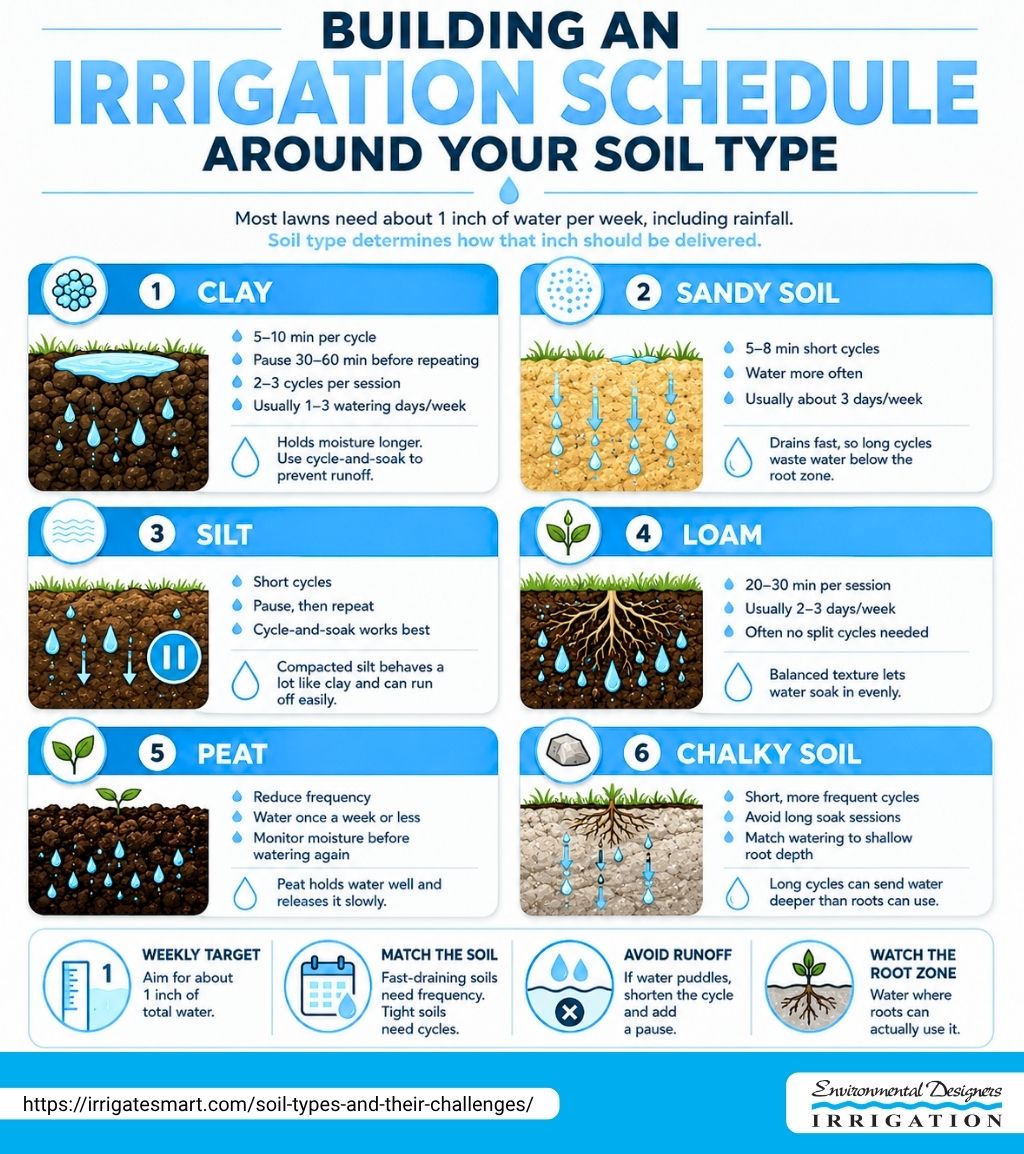
Most lawns need roughly 1 inch of water per week, including rainfall. Soil type decides how that inch gets delivered, whether in one sitting or split across several.
- For clay: Run spray heads for no more than 5 to 10 minutes before the soil hits its absorption limit, then wait at least 30 to 60 minutes before the next cycle. Two to three cycles per session, run two to three times a week, generally delivers the weekly inch without runoff. Clay holds onto moisture longer than other soil types, so some clay lawns can get by on one or two watering days a week rather than three.
- For sandy soil: Run shorter cycles of 5 to 8 minutes, but water more often, typically three times a week, since sandy soil can’t store the same volume between sessions. A single long cycle doesn’t help here. The water has already drained past the root zone before the grass can use it.
- For silt: Treat it like a lighter version of clay. Once compacted, silt behaves close to clay’s 0.1 to 0.2 inch-per-hour range, so the same cycle-and-soak approach applies. Run short cycles, then pause before repeating.
- For loam: A single 20 to 30 minute session two to three times a week generally hits the target without splitting into cycles, since loam’s infiltration rate keeps pace with most sprinkler output.
- For peat: Cut frequency, besides the cycle length. Watering once a week or less is often enough since peat releases moisture slowly and rarely needs topping off between cycles.
- For chalky soil: Short, more frequent cycles match water delivery to the shallow root zone. Long cycles overshoot the depth the roots can actually reach, regardless of how slowly the water is applied.
This is where the controller itself becomes the deciding factor. A standard timer can’t tell the difference between clay and sand. It just runs the schedule it’s given. Smart controllers can be programmed with soil-type and cycle-and-soak settings built in, so the system adjusts run-times automatically by zone instead of applying one schedule across an entire property with mixed soil conditions.
If your current setup is a standard timer, see our guide to upgrading to a smart irrigation system, or check how to program a Hunter sprinkler system if you already have one installed.
Plant Selection and Watering Behavior
Different planted areas pull water at different rates, and a schedule built around soil texture alone can still miss the mark if it ignores what’s actually growing there.

Lawn areas, garden beds, and ornamental plantings each draw moisture differently, which is part of why a single property often needs multiple irrigation zones. Knowing the best time of day to water (generally early morning) also helps limit evaporation loss regardless of soil type, which keeps more of each cycle’s water actually reaching the roots.
Key Takeaways: Matching Irrigation to Soil Behavior
- Two Rates Decide Everything: Runoff happens whenever a sprinkler’s precipitation rate (often 1.4–2.0 in/hour for spray heads) outpaces the soil’s infiltration rate, which is a gap that’s largest on clay (0.1–0.2 in/hour) and smallest on sand (0.8–1.0+ in/hour).
- Cycle-and-Soak Solves the Clay Problem: Short 5- to 10-minute runs with 30 to 60 minutes between them let clay-heavy soil absorb water before the next cycle starts, cutting runoff significantly.
- Sandy Soil Needs Frequency, Not Volume: Shorter 5- to 8-minute cycles, run about three times a week, keep water in the root zone instead of letting it drain past where roots can reach it.
- Smart Controllers Remove the Guesswork: Rain Bird and Hunter systems can apply soil-specific, zone-by-zone scheduling automatically, something a standard clock timer can’t do.
- Testing Beats Guessing: A tuna-can precipitation test and a simple infiltration test tell you which scheduling approach a property actually needs before a single cycle gets adjusted.
Dealing with Runoff, Pooling, or a Lawn That Won’t Green Up?
A schedule that doesn’t match your soil’s infiltration rate wastes water, stresses your lawn, and can lead to runoff that pools in low spots or drains off the property entirely. If you want a CLIA-backed assessment of your property’s soil and zones, a calculated run-time schedule for each area, and a controller setup that adjusts automatically, contact the irrigation team at Environmental Designers Irrigation to schedule an on-site audit.

Recent Posts
Why Sprinkler Wire Splices Fail Underground: And How to Fix It
Gov. Murphy Signs Irrigation Enforcement Bill: What NJ Homeowners Should Know